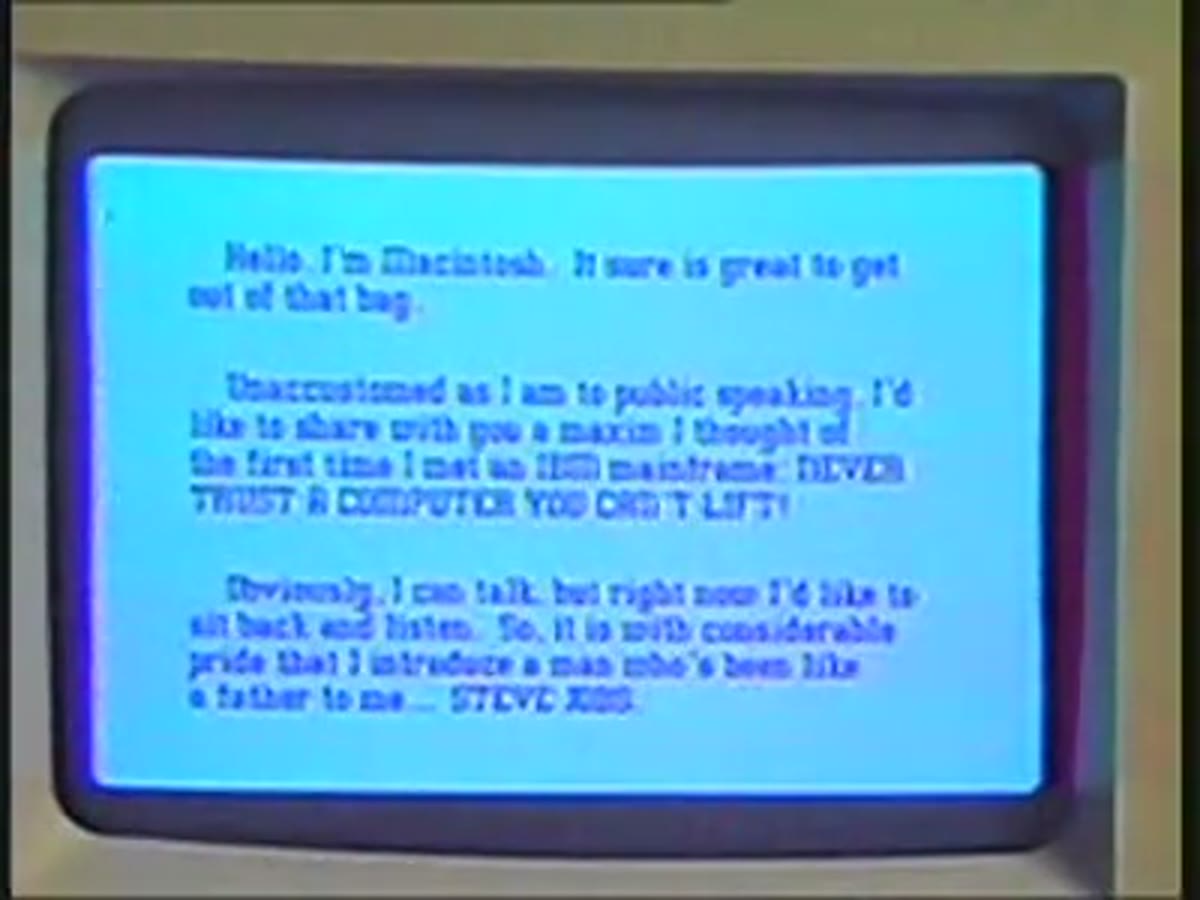
At Apple’s annual shareholders meeting on January 24, 1984, in front of more than 2,000 employees, shareholders and reporters at the Flint Center for the Performing Arts, Steve Jobs introduced the Macintosh by giving it the floor: “I’d like to let the Macintosh speak for itself.” The machine, running an early text-to-speech program, greeted the room: “Hello, I am Macintosh.” Jobs then played Ridley Scott’s Orwellian “1984” television spot, which had aired nationally for the first time during the Super Bowl three days earlier.
Jobs framed the moment explicitly as a fight: IBM, he told shareholders, “wants it all” and threatens an industry “dominated and controlled” future; Apple was “the only force” positioned to stop it. Whatever the Macintosh actually was as a machine (a $2,495 computer with 128 kilobytes of memory), the demo sold something else: a personal computer as an act of resistance, and a product launch staged as a scene from the very dystopian fiction it was warning against.